free browser game
2 Min Drill
Play 2 Min Drill online for free — nothing to install, restart any time, fullscreen supported.

Play 2 Min Drill Online
Launch 2 Min Drill directly in your browser and use fullscreen for the cleanest run.
ready to play
2 Min Drill
Press Play 2 Min Drill to load the game iframe.
Recommended games


2 Min Drill works best in fullscreen. On mobile, rotate your device if the game area feels cramped and use the touch controls shown inside the game.
2 Min Drill Online: A Real Fourth Quarter, One Call at a Time
Two things happen on every snap in 2 Min Drill, and only one of them belongs to you. Before the ball moves you get a real fourth-quarter situation and a menu of calls. After it moves you get a result nobody in the room chose, drawn from a real game played from the same spot.
That split is the whole design. You are not executing a throw; you are setting up the couple of seconds the ball will spend in the air, and the situation either improves across those seconds or slips away. Nothing here is a scramble for a controller. You never carry the ball and you never throw it. What you pick is the concept, the target and the tempo, and the game answers with a play that actually happened.
The grade arrives before the answer does. The game simulates what is left of the match for every call you could have made, works out which one gave your team the best chance to win, and marks yours against it. A completion can therefore be a bad decision, and an incompletion a good one.
It launched on 12 October 2026 as an independent project. The site states it has no affiliation with the league, the teams or the players, and the play data comes from public sources.
The Ball Hangs for Two Seconds, the Call Happens Before the Snap
A thrown ball is airborne for a couple of seconds at most, and by the time it leaves the hand the decision has already been made. That is the whole shape of this game. Everything you control happens before the snap: which family of play, which receiver, whether the line slides, whether the back stays in to block.
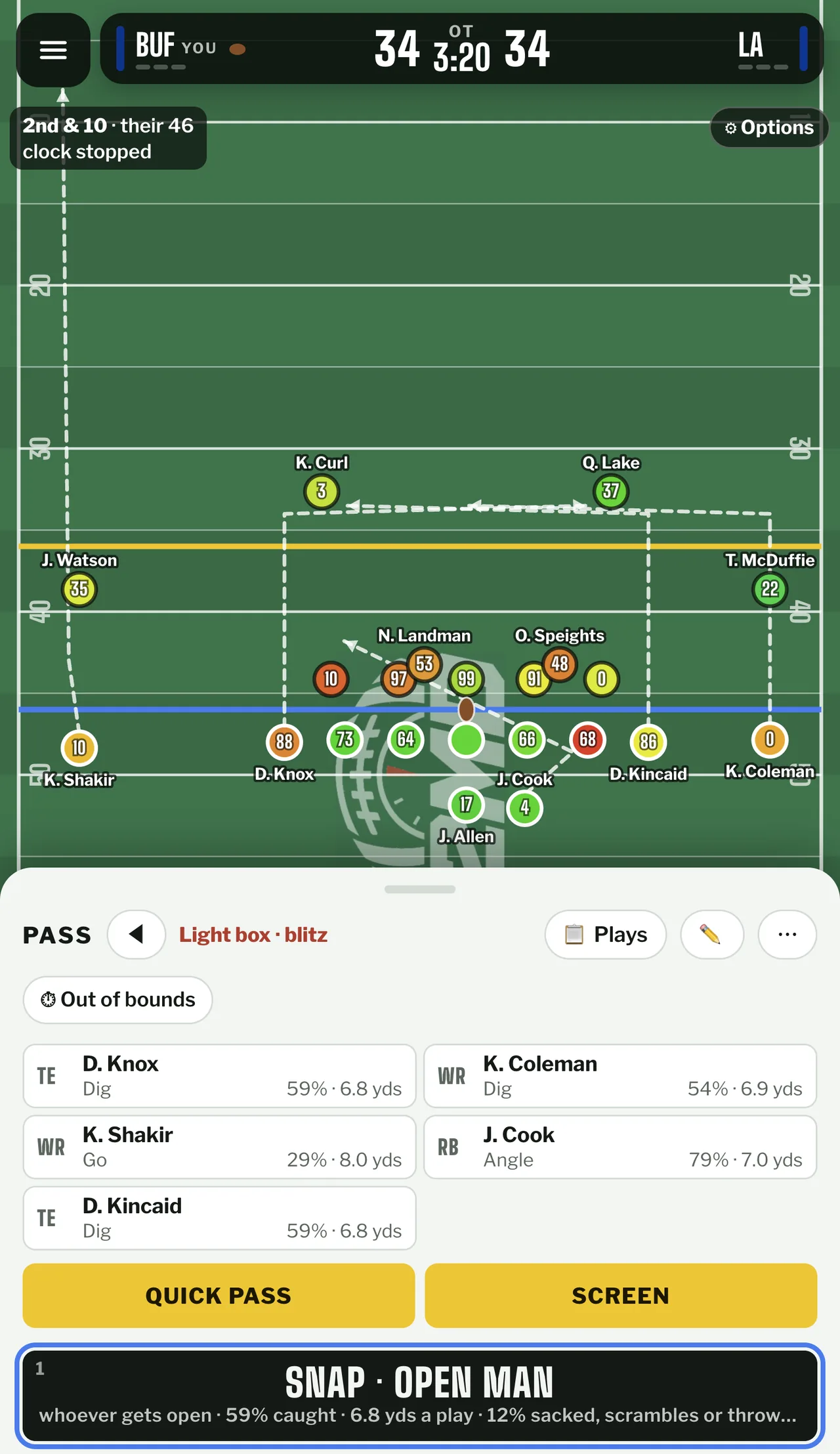
The interface gives you real numbers to work with. Each route drawn on the field carries its success rate in the data, its average gain, and its interception risk. Those figures belong to that route in that kind of situation, not to the receiver in general, so the same player can be a good target on one call and a poor one on the next.
The temptation is to read the numbers as a recommendation and pick the highest success rate. It rarely works, because the defense is not passive. A light box invites a run, a stacked box punishes it, and a blitz changes how long you have to get the ball out. The percentages assume the defense you can see; the call is about what that defense is giving up.
That is the reason the pre-snap read matters more than the play you had in mind walking into the drive.
2 Min Drill Controls: Click, or Press 1 to 9, or Skip the Animation
- 1
Choose a family, then a call
Run, pass, run-pass option and trick plays sit in four groups. Click a group, then the specific call inside it, and the field updates with the routes for that call.
- 2
Pick the target, or redraw the route
Clicking a receiver makes him the target and shows his route. Clicking a route lets you change it before the snap, which is the only adjustment available once the call is in.
- 3
Press 1 through 9
The large buttons on the call sheet carry numbers, and the matching key triggers them. Tab and Enter step through and confirm if you would rather not use the mouse. (1-9)
- 4
Snap, then skip
Snap starts the play. Space skips the animation once you have seen enough, which matters on a phone or when you are replaying a situation you already know. (Space)
Reading the Situation Card Before You Touch Anything
Every drive opens with a card that tells you the score, the time left, the down and distance, where the ball sits, and how many timeouts each side has. It also tells you which team you are coaching, and that choice changes the task completely. Taking the team that is behind means you have to score before the clock empties. Taking the team that is ahead means you have to keep the ball and let the clock empty.
The site describes roughly 740 situations, sorted into three kinds: two-minute drives that need a score, drives that need to protect a lead, and end-of-half spots that need to get into field goal range. The build's data file actually lists 744, four more than the rules page claims, and the gap is not explained anywhere on the site.
The card is also where most players lose their advantage. A drive with three timeouts and 2:40 left is a different problem from the same drive with one timeout, and the difference is not in the play sheet. It is in how many snaps you can afford to waste.
Tempo Is a Clock Decision: Seventeen, Thirty-Four or Thirty-Eight Seconds
Between snaps you choose a tempo. No-huddle burns about seventeen seconds, a normal huddle about thirty-four, and a deliberate milk-the-clock approach about thirty-eight. Those three numbers are the most powerful thing on the screen, and they are easy to ignore because they sit far from the play art.
The arithmetic is blunt. Three consecutive snaps at thirty-eight seconds use nearly two minutes of game clock. The same three snaps at seventeen seconds use under a minute. A team that is behind wants the fast tempo, because it buys an extra possession. If you are ahead, the slow one takes a possession away from the other team, which is the same thing as scoring.
The clock stops are the other half of the calculation. An incomplete pass stops it. Going out of bounds stops it, but only inside the last two minutes of a half and the last five minutes of the game. A timeout stops it. So does the two-minute warning, and so does the end of a scoring play.
Put together, those rules explain why a completed pass in the middle of the field can be worse for a team that is behind than an incompletion near the sideline. The yardage is not the point in that spot. The clock is.
How a Call Is Graded, and Why the Result Does Not Count
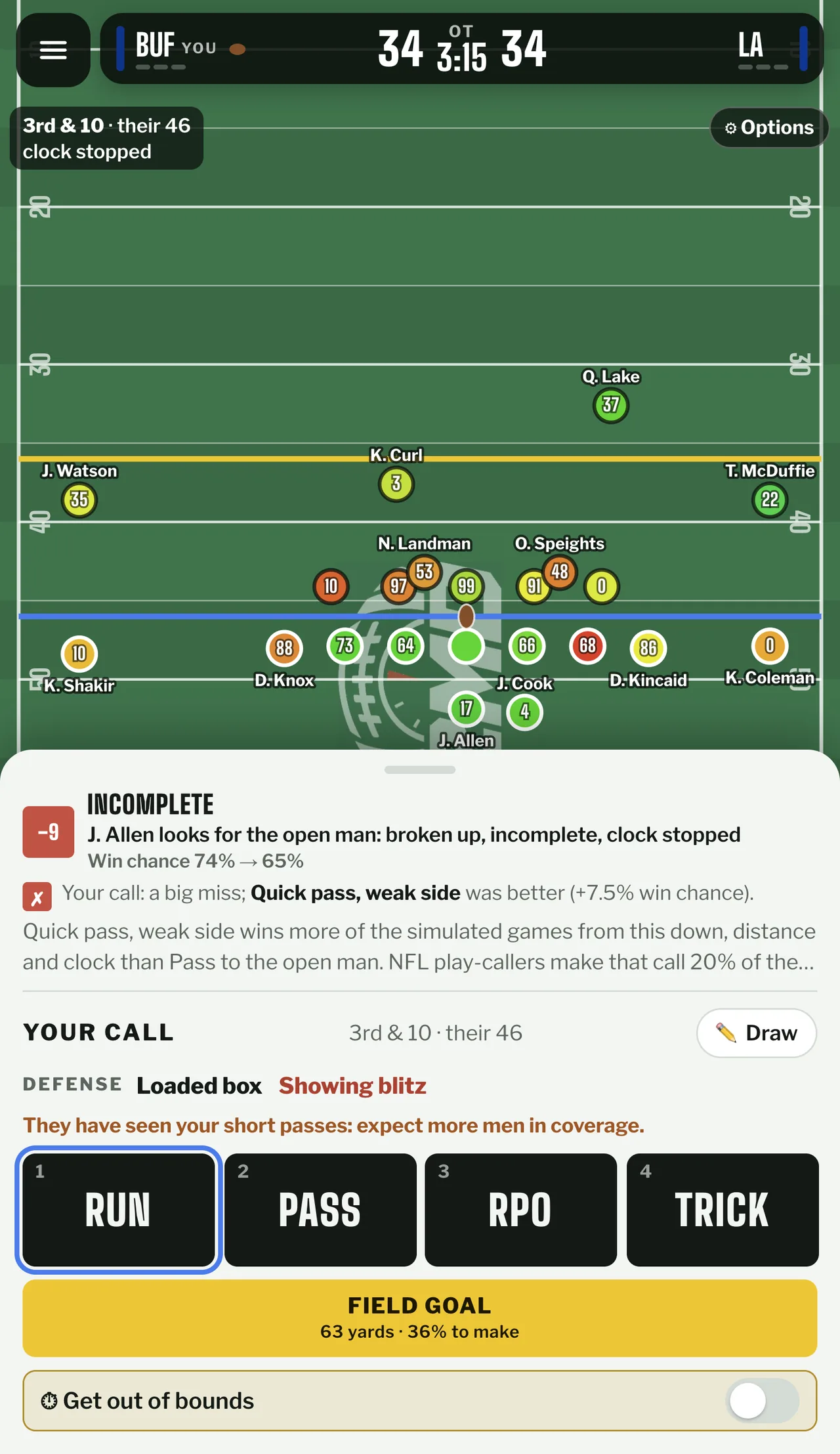
After the snap the game shows how much your call moved the win probability, and colors the decision on a four-step scale. Green means you found the best call or came within half a point of it. Yellow is within two points, orange within five, and red is more than five points worse than the best option available.
The result on the field is a separate thing. It is sampled from more than 160,000 real plays run between 2022 and 2026, matched to your call, your down and distance, and the defensive look. That is why the two can disagree so loudly: a well-graded call can lose yardage, and a red call can break for a touchdown.
Judging yourself by the result is the fastest way to learn the wrong lesson here. A receiver dropping a well-placed ball teaches nothing about play calling, while a completion into tight coverage that should have been intercepted teaches a great deal and will not show up on the scoreboard.
At the end of the drive the game converts your decisions into a percentile by running the same situation past 6,000 simulated coaches. The average sits near fifty, and winning the game adds roughly fifteen to twenty points to the same quality of calls.
The Clock Stops That Decide Your Last Drive
Three tools exist purely to stop the clock, and each costs something. Spiking the ball kills a down. Throwing out of bounds kills a play and often a down with it. A timeout is gone for the rest of the game.
The game models all three, which makes end-of-game management feel less like a quiz and more like a budget. You are spending downs to buy seconds, and the exchange rate depends on where you are on the field. Near midfield with a minute left, a spike is usually cheap. Deep in your own territory with two minutes left, the same spike can cost you the drive.
The two-minute warning is the free stop, and it is worth planning around rather than reacting to. A drive that reaches the warning with timeouts intact has options; one that reaches it empty-handed has to play the sideline on every snap.
None of this is hidden. The game simply refuses to remind you, which is the same thing every real play caller deals with.
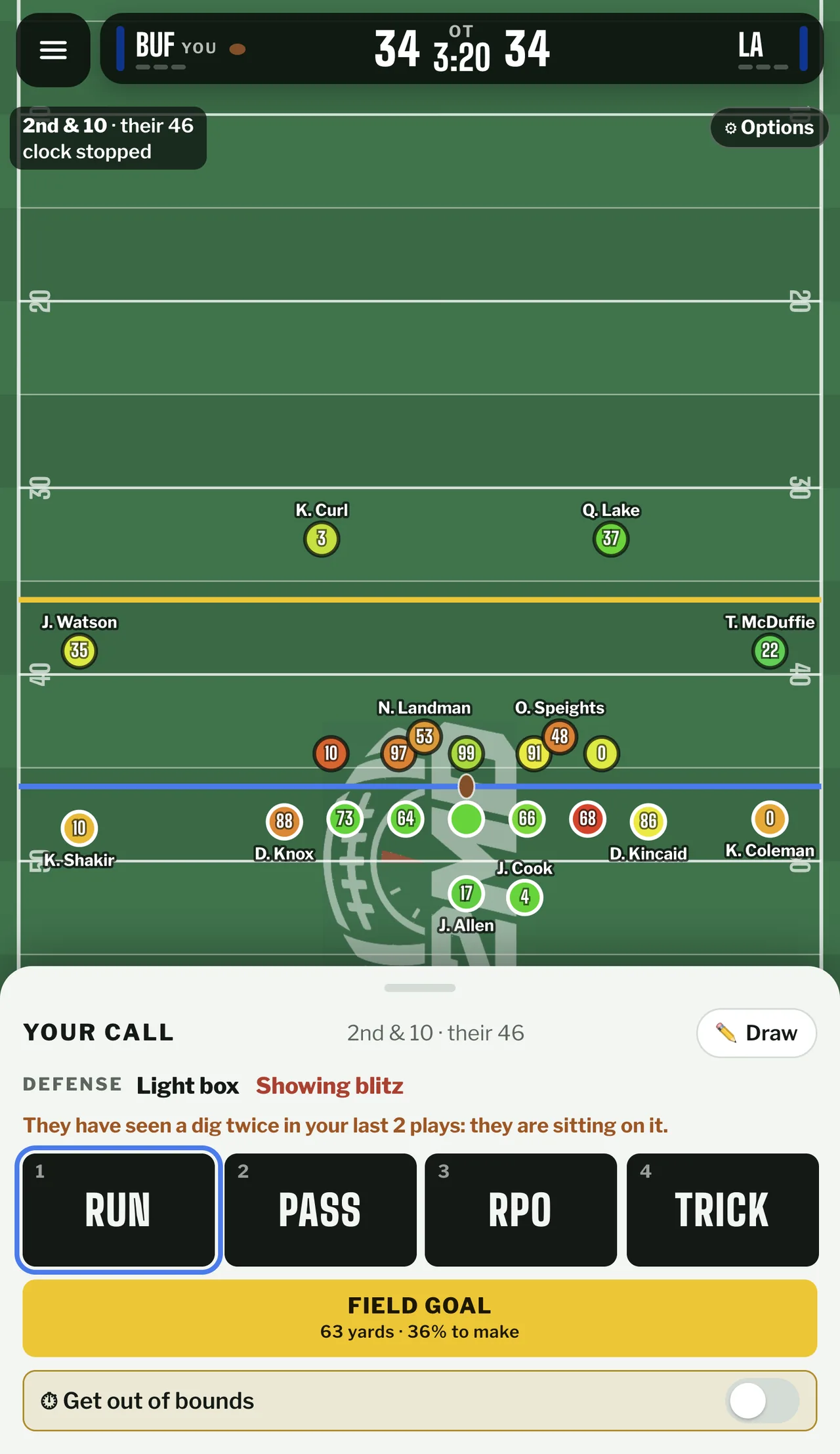
2 Min Drill Screenshots: A Blitz Look, Two Targets and a Ten-Point Drop