
free browser game
Noillirk
Play Noillirk online for free — nothing to install, restart any time, fullscreen supported.

Play Noillirk Online
Launch Noillirk directly in your browser and use fullscreen for the cleanest run.
ready to play
Noillirk
Press Play Noillirk to load the game iframe.
Recommended games


Noillirk works best in fullscreen. On mobile, rotate your device if the game area feels cramped and use the touch controls shown inside the game.
Noillirk Online: A Quiz Where the Clock Is the Only Opponent
Noillirk is a daily survey game that runs in a browser, and the premise fits in one line: name something people would say, then get scored by how close your answer sits to the crowd's first reaction. Ten prompts, thirty seconds each, one attempt a day.
Every prompt is a category rather than a question, so there is nothing to choose from. You type an answer and the game places it against a board built in advance to represent what a hundred people would say. First place, second or third, top five, top ten, or off the board entirely: the position decides what the prompt pays.
That is why this page reads it as a timing game. Knowing a good answer is half the work. Deciding when to stop hunting for a better one is the other half, and the clock bills you for every second of doubt.
What You Can Still Change Inside the Thirty Seconds
Nothing is final until you submit or the timer runs out. A word the game does not recognize comes back as Not on our list with the clock still moving, so a rejected answer costs a few seconds and nothing else. That single rule is what makes the window worth thinking about: you are allowed to change your mind, and the price of changing it is time.
The site is also fair about interruptions. Switching to another tab pauses the countdown, and it resumes when you come back. The last ten seconds turn the progress bar solid red, and the final five add a tick.
Those two details pull in opposite directions. The pause removes the fear of losing a prompt to a phone call, which is generous. The red bar is not generous at all, because it turns the end of the window into something you can feel, and that is the moment a careful player starts typing the obvious answer instead of the clever one.
What hesitation actually costs is written in the scoring table, not in the prompt.
Noillirk Controls: The Four Ways a Prompt Ends
The input surface is a single text field. Type and press Enter, or click the arrow to the right of the field; on a phone the soft keyboard offers a Go key that does the same job. Pass sits beside the field for prompts you cannot place at all. Tapping the table, or the Tap to skip button, hurries the reveal along at the end of a prompt.
Four exits, and only one of them puts a score on the board. Submit ends the prompt with whatever position your answer earned. Pass ends it at zero. A timeout ends it at zero. Closing the tab and coming back later puts you at a resume prompt in front of the question you abandoned.
Pass is the one that gets misread. It guarantees a zero, while an accepted answer never pays less than 10, so passing early gives away points you could have had. The case for it is the clock: with eight seconds left and nothing on the board, a pass and a timeout are the same zero, and the pass at least ends the prompt on your terms.
A Rejected Answer Costs Seconds, Not Points
The checker is looser than most players expect and stricter in one specific place. Case, accents and punctuation are ignored, and so are a leading the, a or an. Plurals count as their singular, some prompts accept the category word attached, and common alternatives work: Lisboa is Lisbon. Answers of five characters or more tolerate one slip, whether that is a missing letter, an extra one, a swapped pair or a plain misspelling. Shorter answers have to be exact, so Rom will not pass for Rome.
The strict part is existence. A perfectly spelled answer that is not on the list comes back rejected, and the only route left is to try something else. When a player is sure the answer should count, the result card offers a Should this count? link that sends the prompt and the answer to the site.
So the failure mode here is not typing. It is choosing an answer the list has never heard of, which usually happens when someone reaches for a precise example instead of the first thing that came to mind.
Settling for the Third Place You Already Have
Once an answer is accepted the prompt is over, so the real choice happens just before you press Enter: hand in what you have, which is probably good but probably not first, or spend more seconds hunting the answer a hundred people would have named first. The bands make that bet worth taking seriously. First pays 100, second and third pay 75, fourth and fifth pay 50, sixth through tenth pay 25, and a valid answer that does not rank still pays 10.
On the opening prompts, where the multiplier is one, the gap between 75 and 100 is 25 points. Fifteen more seconds spent chasing that gap is a poor trade when the next prompt pays 400 for a first place. On the closing prompts the same gap is multiplied by four, and the seconds you are spending have nowhere better to go.
The multiplier table is short, and it changes how a whole run should be paced.
Why Prompts Nine and Ten Are Worth Four Times Prompt One
Base points are multiplied by the position of the prompt. Prompts one and two pay face value, three through five double it, six through eight triple it, and the last two quadruple it. A runner-up answer on prompt ten is therefore worth 300 points, while a first-place answer on prompt one is worth 100. Same knowledge, different slot, three times the return.
Spectators are the other half of the scale. The crowd is a hundred people, one leaves the group for every 25 points, and the division rounds down. That last detail matters more than it looks. An unranked answer worth 10 points buys nobody on the first two prompts, and only starts paying once the multiplier lifts it past 25.
Ten first-place answers at full value add up to 2,500 points, which is exactly enough to move all one hundred spectators. Nobody needs to hit that to enjoy the game. It does explain the shape of a run, though: the last two prompts are worth as much as the first five, so a slow start is recoverable and a careless finish is not.
The clock sets the pace, and the multiplier decides where the pace should be spent.
Noillirk Screenshots: A Prompt Open, an Answer Locked, a Board Revealed
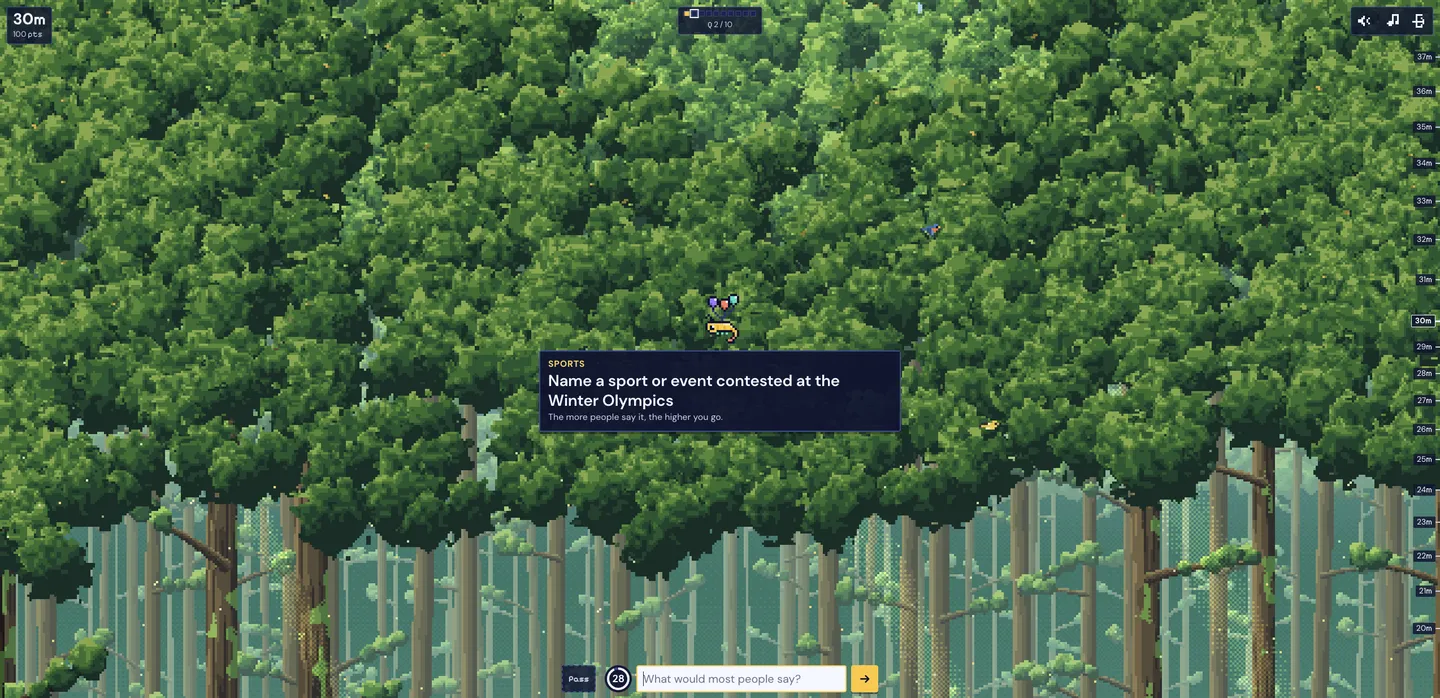
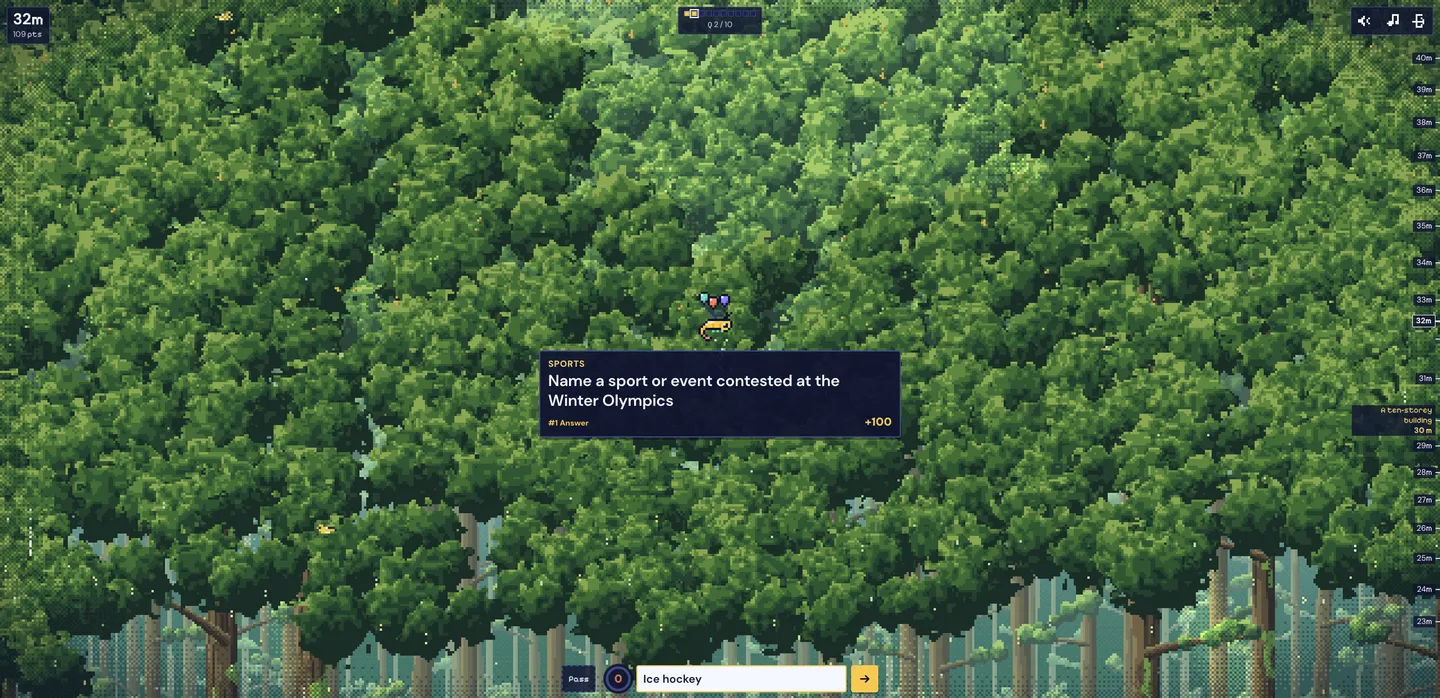
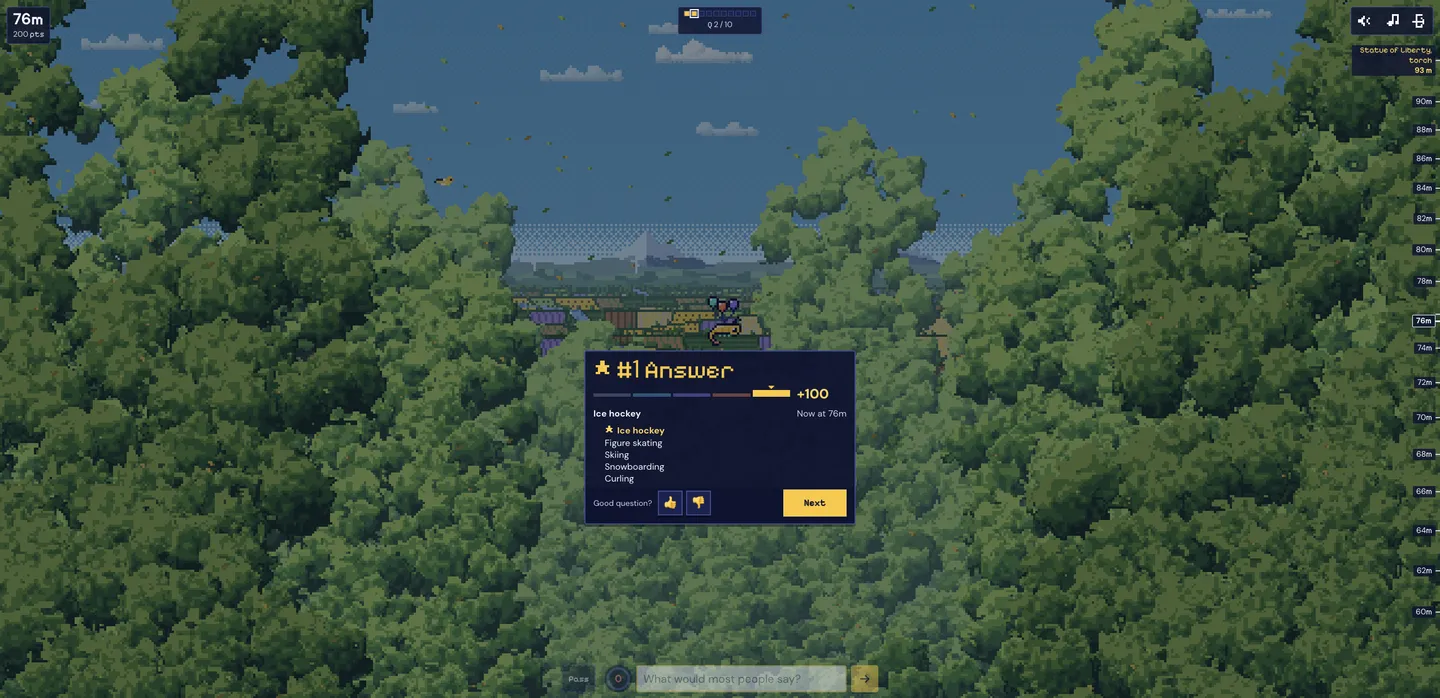
The Height Meter Is a Redrawing of the Score
On the climb stage your total is drawn twice: as points, and as meters on the ruler down the right side of the screen. The three captures on this page make the relationship easy to misread. They show 100 points at thirty meters, 109 points at thirty-two meters, and 200 points at seventy-six meters. Whatever the scale is, it is not one meter per point.
The official scoring page sets out bands, multipliers and the spectator rate, and says nothing about meters. Height is the presentation layer for the same total, and the captures show how unevenly the two move: nine points buys two meters early on, while ninety-one points buys forty-four meters later.
Treating height as a separate objective is the trap. Nothing in the rules rewards altitude on its own, and the percentile you get at the end is computed from points against other players, not from how high the figure climbed.